Last Updated on January 30, 2026
Research from Point Topic notes that global fixed (fiber) broadband lines reached 1.56 billion connections in the third quarter (Q3) 2025. The report shows that South and East Asia dominated the share, reflecting the regions’ adoption of next-generation broadband services for connectivity.
The report shows that the global fixed broadband line subscriptions grew by 1.46% (22.42 million) in Q3 of 2025. It’s an increase of 1.12% from the second quarter of 2025.

Fiber technology continues to dominate
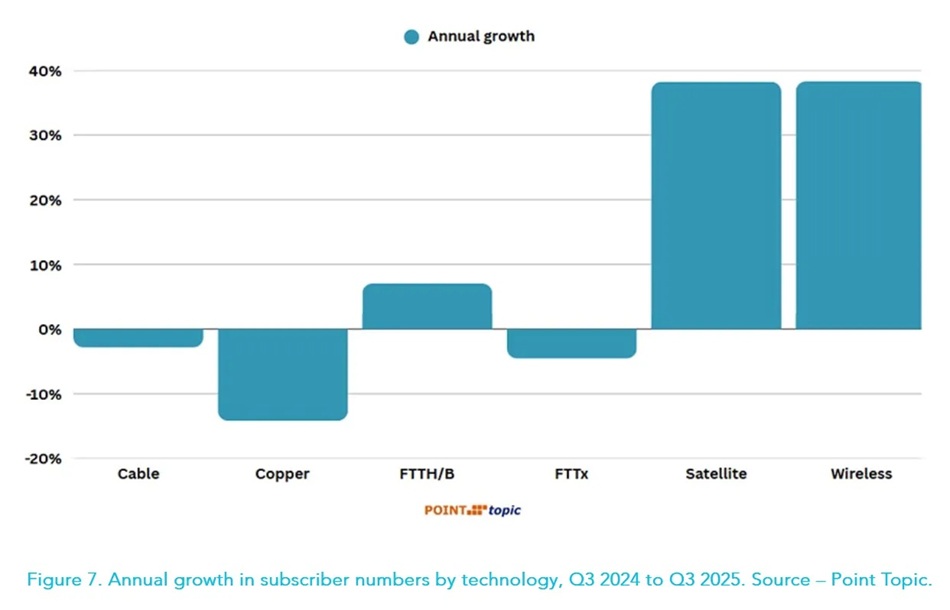
Full Fiber Broadband – FTTH and FTTB increased their market share to 73% after a 7.1% growth in connections in a period of 12 months. The rise in fiber-based technology adoption means continuous shrinkage of older technologies. Cable, FTTx-based services, copper, etc., lost their base further.
Fiber, though, rose from 72.61% to 73.09%. “While the decline in legacy copper and part copper is not surprising, cable/HFC also appears to be on the way out in some markets,” said Point Topic.
The report mentions that between Q2 and Q3 of 2025, copper lines declined from 4.03% to 3.82%. Cable service likewise went from 11.07% to 10.83%, while hybrid fiber connection also saw its market share fall from 8.45% to 8.21%. Find out the difference between Fiber vs ADSL to learn more about why the former is a better technology.
Satellite connectivity is the future
Further, satellite and fixed wireless access have continued to chart further in the table. Especially, low Earth orbit (LEO) satellites are increasing their stakes at the moment. And while 5G is getting more scale-ups, it’s also leading the use of FWA (Fixed Wireless Access) globally.
To put it into figures, satellite broadband took a 0.52% market share in Q3, 2025, which was an increase of 0.5% from Q2, 2025. It does seem slim at the moment; however, the growth trajectory is likely to reach North of it in the coming months. Policy makers, telcos, and smartphones are all gearing up to make satellite connectivity a flagship option, and this will further push for more of this technology growth. What’s so stunning is that the report shows that satellite connections grew by 38.2% in 12 months.
SpaceX-operated Starlink has been responsible for expanding the growth in satellite connectivity. It says that its official base has reached 9.2 million at the start of 2026. The company has 2.4 million users in the US, 0.6 million in Canada, and 0.4 million in Brazil and Argentina. Its widening footprint in Asia, so that figure will see a hike later in 2026.
Check out 5G vs fiber: Which one’s better?
FWA is rising too
FWA, on the other hand, made a growth of 3.15% after a growth of 38.3% in 12 months, just like satellite connections. The US and India are coming as great market takers for FWA. Both countries saw 1.2 million users each in Q3, 2025.
“Competition from telcos who are rapidly expanding their fibre footprints is hard to beat, and 5G FWA home broadband offerings from Verizon, T-Mobile and AT&T have exploded, with their customer numbers jumping year-on-year by 28%, 33% and 168% respectively,” Point Topic states, “In India, 5G FWA connections shot up by 236% year-on-year, with both Reliance and Bharti Airtel continuing to invest aggressively in their 5G FWA rollouts.”
As fiber unlocks gigabits of data rates, it’s likely to extend its clout worldwide, and FWA is also going to rake in more base for its easier access to 5G-powered internet speed.