

Last Updated on June 10, 2026
Crypto in 2026 does not move like one giant market anymore. That old idea that “Bitcoin goes up and everything follows” is fading fast.
Right now, btc price is holding steady around the $77,000 range while Ethereum is struggling near $2,075 after losing major technical support. The difference between the two is becoming hard to ignore.

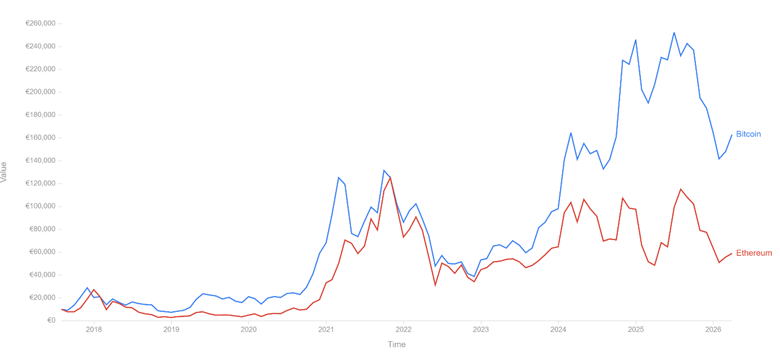
Bitcoin vs Ethereum: Historical performance
This is not just another temporary correction. The market is starting to treat BTC and ETH as completely different types of assets.
Bitcoin is increasingly viewed as a digital reserve asset, basically the crypto version of macro protection. Ethereum still powers a huge part of the blockchain economy, but it is behaving more like a high-growth tech asset tied closely to liquidity conditions and investor risk appetite.
That separation is shaping the entire 2026 market cycle.
ETH/BTC ratio tells the whole story
One of the clearest signals in crypto is the ETH/BTC ratio. It gives a sense of whether the market is in a risk-taking mood or shifting toward caution.
- Rising ETH/BTC ratio = more appetite for risk
- Falling ETH/BTC ratio = capital rotating into Bitcoin
In 2026, it has dropped to around 0.027, sitting near multi-year lows.
| Period | ETH/BTC Ratio | Market Behavior |
| 2021–2022 | 0.06 to 0.08 | Balanced market cycles, more rotation between Bitcoin and Ethereum |
| 2023–2024 | 0.05 to 0.07 | Mixed rotation, shifting momentum with no clear dominance |
| 2026 | ~0.027 | Strong Bitcoin dominance, capital concentrating into Bitcoin |
That drop tells a pretty simple story. Investors are prioritizing stability and liquidity over higher risk exposure.
Why Bitcoin is holding stronger?
Bitcoin’s biggest advantage in 2026 is institutional demand.
Spot Bitcoin ETFs are still attracting steady long-term money from funds, corporations, and wealth managers. Even when there are short-term outflows, the broader trend still points upward.
A lot of BTC is also being locked away inside ETFs and treasury holdings, reducing exchange supply. Fewer coins available on the market means demand shocks can push prices higher faster.
Bitcoin is no longer just a speculative trade. It is increasingly treated like a macro asset similar to digital gold.
Current BTC strengths include:
- Strong ETF inflows
- Fixed supply and scarcity
- Clear store of value narrative
- Lower perceived risk compared to altcoins
- Growing regulatory clarity
The downside is that Bitcoin’s size limits explosive gains. It takes massive capital inflows to move BTC significantly compared to smaller crypto assets.
Still, in uncertain markets, investors seem comfortable parking money there.
Ethereum’s problem is more complicated.
Ethereum is still the largest smart contract ecosystem in crypto. It dominates decentralized finance, tokenization, and blockchain infrastructure.
But the market is clearly less confident about its short-term outlook.
One reason is ETF demand. Ethereum ETFs have not attracted the same level of institutional buying as Bitcoin products. Instead of seeing ETH as a reserve asset, many investors still see it as a technology play.
The success of Ethereum’s own scalability is another problem.
Users benefit greatly from speedier and less expensive transactions through Layer 2 networks like Base and Arbitrum. But there is a tradeoff. More activity is moving away from the Ethereum base layer.
That means:
- Lower transaction fees on the Ethereum mainnet
- Reduced ETH burn
- Weaker scarcity pressure
- Periods of mild inflation returning
This has weakened Ethereum’s old “ultrasound money” narrative that helped support prices in previous cycles.
At the same time, competition from Solana and other fast Layer 1 chains keeps growing.
BTC vs ETH: Where things stand now ?
| Factor | Bitcoin | Ethereum |
| Price | ~$77,300 | ~$2,075 |
| Market dominance | ~58% | ~15% |
| Technical trend | Above 200-day MA | Below 200-day MA |
| Market behavior | Macro asset | Growth tech asset |
| Supply model | Fixed scarcity | Variable supply |
What could happen next?
Bitcoin appears to be building a strong base between $73,000 and $75,000. If BTC breaks above the $80,500 level, analysts expect momentum could push prices toward the $100,000 to $105,000 range later in 2026.
The market increasingly treats Bitcoin as a macro liquidity indicator. When global liquidity improves, BTC usually reacts first.
Ethereum’s setup is different.
ETH is sitting near major support levels between $1,900 and $2,020. Over time, these tight valuation ranges have usually set the stage for sharp rebounds once market sentiment shifts.
If liquidity conditions improve and investors rotate back into higher-risk assets, Ethereum could recover aggressively. Some long-term bullish models still point toward the $6,000 to $8,000 range in a strong expansion cycle.
That said, ETH likely needs stronger ETF adoption and healthier mainnet economics before momentum fully returns.
Final thoughts
The biggest mistake investors make in 2026 is treating Bitcoin and Ethereum like they serve the same purpose.
Bitcoin is becoming the reserve layer of crypto. It attracts institutional money because the narrative is simple: scarce digital value storage.
Ethereum is the infrastructure layer. It powers applications, tokenization, and decentralized finance, but it also carries more complexity and more competition.
One represents stability. The other represents innovation. And right now, the market is rewarding stability more than growth.
FAQs
Why is Ethereum underperforming Bitcoin in 2026?
Things are a bit shaky for Ethereum right now. Less ETF inflow, weaker fee growth as scaling kicks in, and rising competition from new chains are all slowing it down. On the flip side, Bitcoin keeps pulling institutional interest because it’s straightforward. Basically, the “digital gold” story still works.
What does the ETH/BTC ratio of 0.027 mean?
This means investors are favoring Bitcoin over Ethereum. When this ratio gets this low, it usually shows a cautious market where people look for stability and easy liquidity.
Is Ethereum still deflationary?
Not consistently. Lower activity on Ethereum’s main chain has reduced ETH burn rates, causing periods where supply becomes slightly inflationary.
Can Ethereum still outperform Bitcoin later in the cycle?
Yeah, ETH has historically done well when money flows back into risk assets. In a more upbeat market, it usually moves faster than Bitcoin on the upside because it’s more volatile and tied closely to growth and speculative demand.
What role do ETFs play in Bitcoin and Ethereum performance?
Bitcoin ETFs are attracting strong, steady buying from institutions, which is slowly shrinking the amount of BTC available on the market. Ethereum ETFs haven’t gained the same traction yet, largely because they don’t integrate staking rewards into the ETF structure, limiting their appeal for now.
Is Bitcoin still a good growth asset or just a safe haven now?
Bitcoin is gradually behaving like a macro safe-haven asset, though it still carries strong growth potential. What’s changed is that its price action is now driven more by institutional inflows and broader liquidity cycles, rather than individual retail speculation.