Last Updated on April 23, 2026
Summary✨
- The Ministry of Physical Infrastructure and Transport proposes Digital Mobility Service Operation Standards 2082 to legalize ride-hailing in Nepal.
- The standards differentiate between ride-hailing and ride-sharing, clarifying their roles and objectives.
- Vehicles used for ride-hailing must meet specific criteria, including pollution standards and safety features.
- The government sets minimum fares at Rs 55 per kilometer for four-wheelers and Rs 25 for two-wheelers, with additional charges allowed during peak times.
- Non-compliance with safety regulations will lead to penalties, establishing a zero-tolerance policy for irresponsible driver behavior.
The Ministry of Physical Infrastructure and Transport (DoPIT) has prepared a Draft of Digital Mobility Service Operation Standards 2082 to legalize ride-hailing service in Nepal. The milestone document serves as a fresh step towards legalizing the industry after years of pressure and calls for federal recognition for the growing gig economy.
The standards aim at making ride-sharing a properly managed, secure, and regulated sector. The government has already recognized ride-sharing as an industry. However, there is a lack of guiding regulations to monitor the industry. The standards help towards making it a legitimate industry while giving stakeholders long-sought relief with the federal government’s recognition. It helps platforms such as inDrive, Pathao, Sajilo, etc. to operate their service with more legal compliance and the government’s legal assurances.
Ride-Hailing Standards Overview
Ride-hailing vs ride-sharing
The government has clearly distinguished between ride-sharing and ride-hailing. This helps clear long-held confusion as to how the service shall be viewed. According to the government, ride-hailing is a transportation service where passengers request and use a vehicle or a vehicle with a driver according to their needs through a digital platform, and payment, tracking, and service management are done in direct coordination with the service provider.
In the meantime, ride-sharing is treated as a service that enhances vehicle utilization, reducing travel costs, and minimizing traffic congestion and environmental impact by providing space for more passengers to share a ride towards the same destination.
It’s established that vehicles used for these services shall not be older than 15 years from the date of their manufacturing.
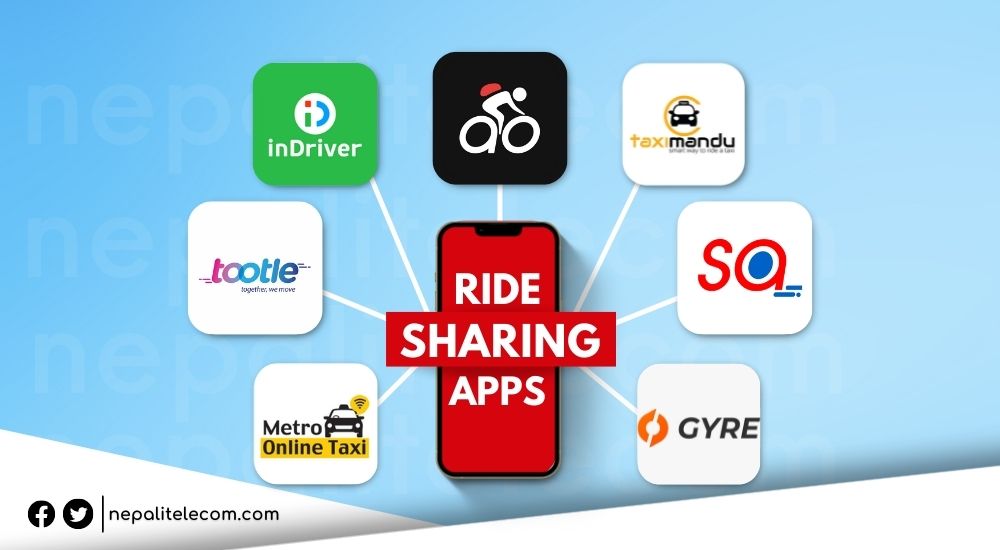
Also: Top Ride-Sharing Apps in Nepal | Taxi-Booking | Latest 2026
Rules for vehicles used for ride-hailing in Nepal
According to the Transport Ministry, these are the minimum criteria vehicles and drivers must meet for ride-sharing/hailing services.
- Two-wheeler petrol vehicles used for ride-sharing/hailing must pass the pollution standard tests. For electric two-wheelers, they must have a minimum pick-up power of 1.5kW and a maximum speed of more than 40 kmph.
- It is the same for four-wheelers too, and a luggage compartment of 200 liters must be ensured.
- Two-wheelers must also have a real-time GPS tracking system, an emergency button to send an alert to the service provider and the police control room, and helmets for both driver and passenger.
- The four-wheelers must also have an alert button, a tracking button, and a first-aid kit.
- The driver should be at least 18 years of age, and the license should have been held for at least 1 year.
- The driver should not be addicted to any substance and must be physically and mentally fit to drive.
- It’s also mentioned that the driver must not be involved in any criminal activities and should be able to use smartphone apps for service.
- The driver must be familiar with all traffic rules and concerned laws.
Check out: In-app call feature on inDrive for rides; Find its advantages
Minimum fare for ride-hailing service in Nepal
The government has also set a minimum fare for ride-hailing in the standards draft. It mentions that the service provider will have to set a base fare for the distance of each route. Here are more details.
- Four-wheelers’ base fare for ride-hailing is Rs 55 per kilometer.
- The base price for two-wheelers is Rs 25 per kilometer.
- The draft also proposes that the service provider can charge a minimum fare of two kilometers, irrespective of the journey’s distance.
- The platforms can also set the charge higher for ride-hailing during nighttime, adverse weather, idle time, etc.
The draft highlights that platforms can only charge a 10 percent commission from the drivers per ride. The driver will keep the rest.
The draft says that the Department of Transport Management will build and manage a central system for operating and managing digital mobility services. The apps operated by the platforms shall be linked to the same system through an API. This will oversee the service provider’s app, transaction regulation, and grievance addressing.
Legal action for not ensuring safety and security
Penalty for drivers in case of irresponsible behavior. In case of non-compliance, strong action will be taken against the perpetrators. A zero-tolerance policy has been established regarding the safety and security of the drivers and passengers.
According to the draft, a driver can be warned or fined; there will also be a provision for a fine and legal action for specified offenses. At the same time, drivers must also be treated with respect by the passengers.
The draft will now be presented to the transport minister. After this, the minister or the cabinet will approve it before implementation.
FAQs on ride-hailing operation standards in Nepal
It is a draft regulation by the Ministry of Physical Infrastructure and Transport to legalize and regulate ride-hailing services in Nepal.
Ride-hailing involves booking a vehicle via an app for personal travel, while ride-sharing allows multiple passengers to share a ride to reduce cost and traffic.
The proposed minimum fare is Rs 55 per km for four-wheelers and Rs 25 per km for two-wheelers.
Drivers must be at least 18 years old, hold a valid license for at least one year, and be physically and mentally fit.
Platforms can charge up to 10% commission per ride from drivers.