Last Updated on June 18, 2026
Summary✨
- 5G has surpassed 3 billion subscriptions and now carries half of global mobile data traffic, with expectations to reach 85% by 2031.
- Nepal leads in mobile data usage with an average of 37 GB per smartphone per month, projected to rise to 70 GB by 2031.
- Mobile networks are experiencing a critical shift as uplink traffic outpaces downlink traffic, driven by AI and user behavior.
- 5G monetization through network slicing is gaining momentum, with commercial offerings increasing by 58% in just six months.
- Nepal needs to prioritize mid-band 5G spectrum allocation and treat 5G FWA as a key strategy for rural broadband expansion.
Ericsson’s June 2026 Mobility Report states that the global 5G subscriptions have crossed 3 billion, carrying half of all mobile data traffic. And while 5G and 6G are dominating much of the discourse, silently, the data landscape has a stunner. No more is downloading the dominant talks in data; uplink is slowly becoming the next big thing, thanks to the rapid growth of AI.
Table of contents
- 5G is now more relevant than ever
- The Nepal region: Data heavy and on the rise
- Uplink: the network is flipping
- Slicing and differentiated connectivity: 5G’s monetization story
- Proof in the real world: SoftBank sliced network at the F1 Japanese Grand Prix
- Satellite fills the gaps
- 6G is taking shape — around 2030
- What does the mobility report means for Nepal?
- FAQs on Ericsson Mobility Report, June 2026
5G is now more relevant than ever
5G subscriptions have reached 3.1 billion in Q1 2026, adding 162 million in a single quarter. That owes to 390 operators launching commercial 5G worldwide, and more than 90 of them running 5G Standalone (SA). And the thing is, there is no debate in the Standalone vs Non-Standalone 5G battle. The former is the clear winner.

The report emphasizes that 5G is no longer a new -generation technology but a completely relevant one. It now carries half of all mobile data traffic globally (48 percent, up from 34 percent a year earlier), and Ericsson projects that share to reach 85 percent by 2031. 5G subscriptions are expected to reach 6.4 billion by 2031, two-thirds of all mobile connections on the planet.
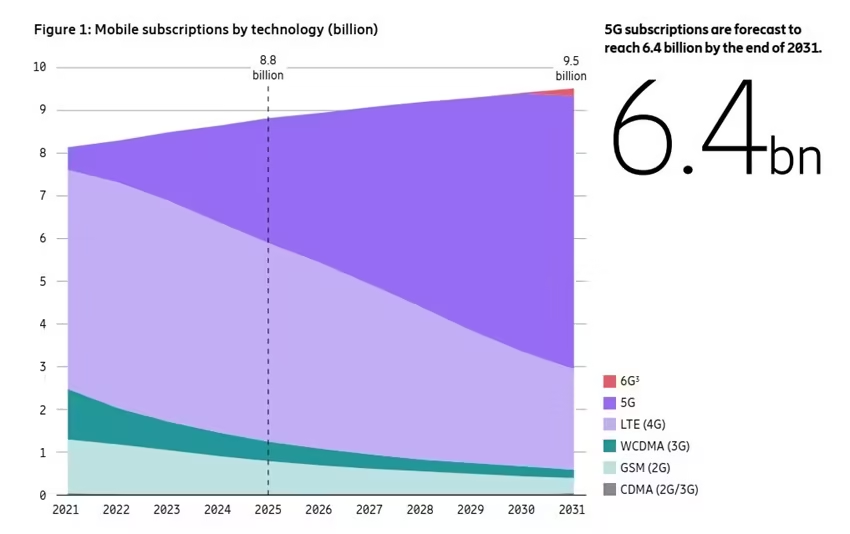
The rise of 5G has also entailed the fall of older-generation technologies. In Q1 2026 alone, 4G lost 77 million subscriptions (falling below 4.6 billion), 3G shed 18 million, and 2G lost 23 million. By the end of 2025, 80 operators had completely shut down their 3G networks, and 46 had fully phased out 2G. The phase-out of 3G is now expected to run ahead of 2G, since 2G’s minimal spectrum footprint keeps it useful for voice and legacy IoT a while longer.
- In Q1 2026, 4G subscriptions declined by 77 million, falling below 4.6 billion.
- During the same period, 3G subscriptions dropped by 18 million.
- 2G subscriptions also decreased by 23 million in Q1 2026.
The Nepal region: Data heavy and on the rise
Nepal is grouped together with India and Bhutan in Ericsson’s report. This region holds a remarkable distinction: The highest average mobile data use per smartphone in the world — 37 GB per month at the end of 2025, against a global average of just 22 GB. More amazingly, by 2031, that figure is expected to reach 70 GB. It means the demand for data, fueled by video content and AI, is only going to rise further.
In the region, 5G reached 430 million subscriptions (35 percent of all mobile subscriptions) by the end of 2025 and could climb to roughly 1.1 billion — 81 percent penetration — by 2031, while 4G falls from about 570 million to 160 million. Affordable 5G phones and aggressive 5G FWA expansion are the twin engines. No telco has yet been able to launch 5G network in Nepal, but the regional growth is already extraordinary.
Uplink: the network is flipping
The exceptional rise in the uplink metric is the major shift witnessed in the report. Mobile networks have always been about downlink dominance — video streaming, web browsing, and content coming down to the user. That is changing now.
Across 55 operators Ericsson studied in 2025, 43 had faster growing uplink traffic than downlink, and 17 saw uplink grow more than 1.5 times faster. According to Ericsson, three factors are fueling uplink growth:
- AI-native smartphones and user behavior: As hundreds of millions of 4G phones are replaced by 5G devices each year, the base of 1080p-and-higher cameras grows. A single HD video call pushes 1–3 Mbps up per stream, and short-form clips, live streaming, and phone-to-cloud backup add steadily to uplink load.
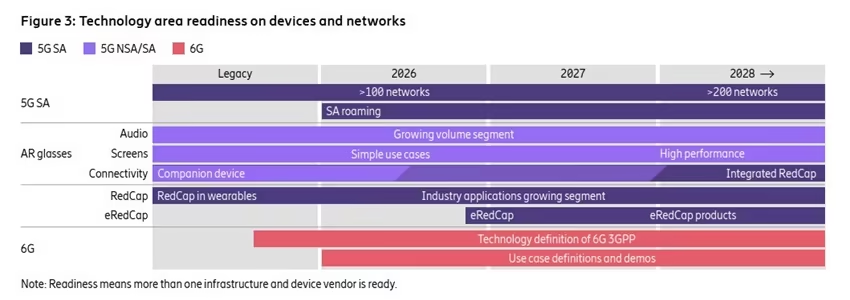
- AI/AR smartglasses: These devices stream camera, audio, and sensor data continuously to cloud AI, producing a download-to-upload ratio of roughly 1:8 — heavily uplink-dominated — at 1–10 Mbps per device. Power constraints force aggressive duty-cycling that spikes instantaneous uplink demand even higher.
- Agentic AI: Autonomous, always-on AI systems generate continuous uplink traffic of a kind that networks were never designed to absorb.
Slicing and differentiated connectivity: 5G’s monetization story
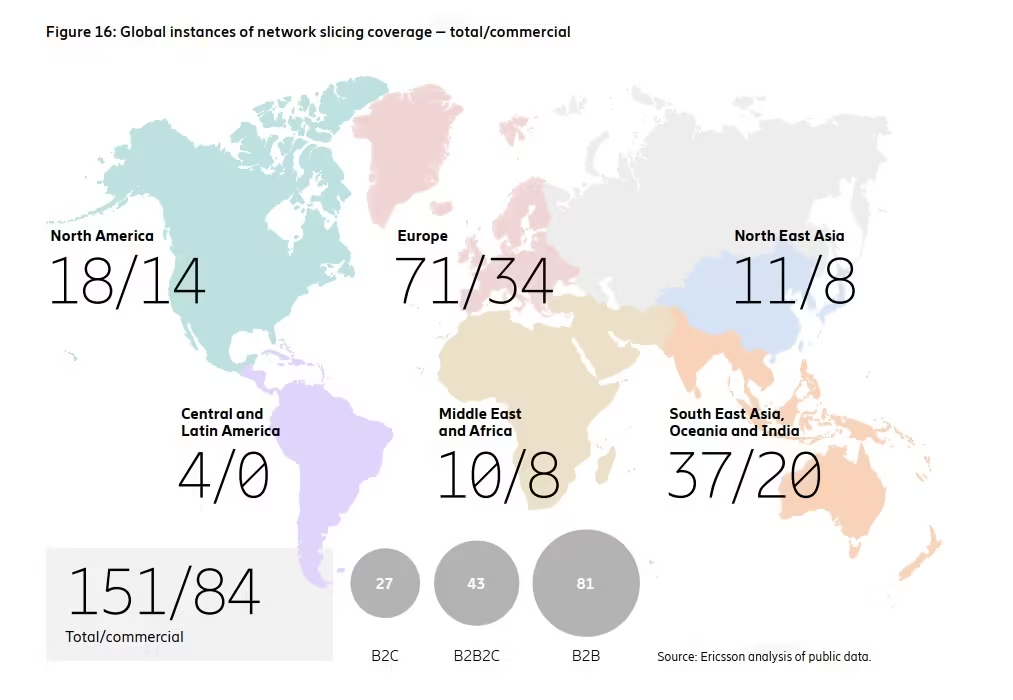
5G SA is finally being monetized through differentiated connectivity. Commercial offerings based on network slicing jumped from 65 to 84 in just six months, which is a 58 percent annual growth rate. Europe leads (about 41 percent of offerings), followed by Asia-Pacific (24 percent). Most are B2B, but consumer “boost” products for gaming, live events, and video calling are growing.
Proof in the real world: SoftBank sliced network at the F1 Japanese Grand Prix
SoftBank demonstrated network slicing at the 2026 Formula 1 Japanese Grand Prix in Suzuka, where 315,000 people streamed, posted, paid, and watched simultaneously, over three days. SoftBank built five network slices on shared 5G SA infrastructure — covering general users, payment terminals, mmWave Wi-Fi, wireless broadcast cameras, and XR — after first doubling cell count with Massive MIMO and adding mmWave capacity.
Satellite fills the gaps
Low-Earth-orbit satellite broadband is growing from around 10 million subscriptions in 2025 to about 33 million by 2031, complementing fiber and 5G FWA for hard-to-reach areas. The technology offers broadband connectivity even in areas that are underserved due to their geographical complexities. Speaking of which, many are eagerly seeing the possibility of Starlink internet in Nepal.
6G is taking shape — around 2030
5G’s successor, 6G, is already making headlines and developments. The first implementable 6G specifications are targeted for late 2028 or early 2029, with first commercial services expected around 2030 in early-5G markets (US, China, Japan, South Korea, the GCC). India is also keeping pace with the global leaders to accelerate its 6G timeline relative to its 5G rollout. Global 6G subscriptions are expected to reach 180 million by the end of 2031.
What does the mobility report means for Nepal?
The mobility report serves as a checklist for Nepal’s next five years: accelerate mid-band 5G spectrum allocation, plan networks for an uplink-heavy traffic, and treat 5G FWA as a serious rural-broadband strategy. The report also suggests that Nepali telcos must keep the 3G sunset moving to become spectrum efficient and bring 5G asap.
FAQs on Ericsson Mobility Report, June 2026
Global 5G subscriptions have surpassed 3 billion, and 5G now carries nearly half of all mobile data traffic worldwide.
Nepal, India, and Bhutan have the world’s highest smartphone data usage, averaging 37 GB per month per user in 2025.
AI applications, video calls, live streaming, and cloud services are increasing upload traffic faster than download traffic.
5G can deliver faster mobile internet, support AI-powered services, and expand broadband access in rural areas through Fixed Wireless Access (FWA).
The country should allocate 5G spectrum, strengthen network infrastructure, and prepare for rising AI-driven data demand.