Last Updated on September 17, 2026
Summary✨
- Ncell celebrates its 21st anniversary, evolving from Mero Mobile, and impacting Nepal’s digital transformation.
- The company has over 14 million subscribers and provides significant 4G coverage to around 95% of the population.
- Ncell has invested over Rs 130 billion in network expansion and technology upgrades over the past decade.
- Despite market challenges, Ncell continues to play a vital role in Nepal’s shift towards a digital economy.
- The firm’s commitment extends beyond connectivity, with over Rs 2 billion invested in CSR initiatives since its establishment.
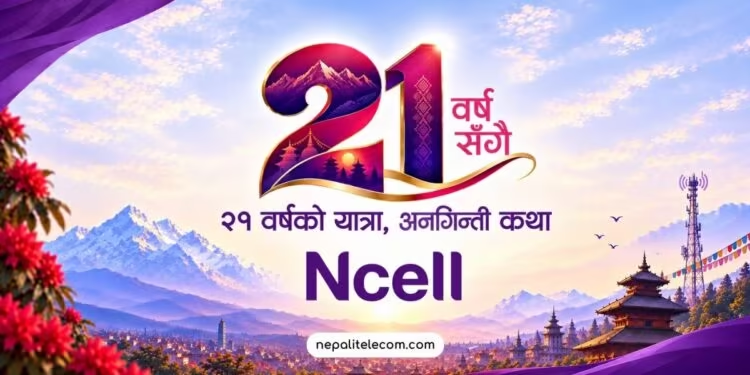
Ncell celebrates its 21st anniversary today (September 17, 2026). Beginning as Mero Mobile in 2005 and continuing its journey as Ncell in 2026, the company has continued its major contribution to the digital transformation of the country, despite various ups and downs.
As the company marks its over 2 decades of journey, it reflects not only the evolution of a telecom operator but also the transformation of how Nepal communicates, works, learns, does business, and accesses digital services.

The company began its journey as Spice Nepal Pvt. Ltd., launching its service under the Mero Mobile brand in 2005. After over two decades, the private operator has grown into one of Nepal’s largest telecommunications companies, with a subscriber base of over 14 million.
Back in the time when getting a SIM card took months, Ncell stepped in to provide it in a few minutes at stores. That’s how it transformed the way mobile services work in the country.
Its journey has also followed the rapid evolution of mobile technology—from GSM and GPRS to EDGE, HSPA, 3G, and 4G. Ncell is also seeking approval to launch 5G in Nepal.
From Mero Mobile to Ncell
Ncell’s history is closely linked with some of the most important developments in Nepal’s mobile telecommunications sector.
The company Spice Nepal Pvt. Ltd. started in 2004. It launched cellular services under the brand Mero Mobile in 2005. In 2008, TeliaSonera acquired the company; then the company was rebranded as Ncell in 2010.
In 2010, Ncell launched 3G network, bringing faster mobile data services to Nepali users. The network unlocked video calling capacity while also facilitating YouTube consumption. Another milestone came in 2016 when Axiata acquired Ncell with an 80% stake. In 2017, the company launched a 4G network.
Then, the company was converted into a public limited company in 2020. In 2023, the company saw an ownership change again, with Spectrlite UK Ltd. taking over Ncell. Axiata left Ncell in late 2023, citing different business priorities.
The Malaysian company’s exit hasn’t been all positive. There’s a chance that it might affect foreign direct investment in the country’s telecom landscape. As it said, it left for a difficult business environment in the country.
Despite changes in ownership and corporate structure, the company has continued to operate and expand its telecommunications infrastructure in Nepal.
Building one of Nepal’s largest mobile networks
Today, over 95% of the population has Ncell’s 4G service. Around 92% of the population has 2G coverage. Having said that, Ncell has started shutting down the 3G network as it focuses on improving newer and more advanced services.
The network has become useful beyond just phone calls. The services have become indispensable for digital payments, social media browsing, streaming, e-learning, remote work, entertainment, etc.
In this sense, the development of mobile networks has accompanied Nepal’s broader shift toward a digital economy.
More than Rs. 130 billion invested in Nepal
Ncell’s contribution can also be viewed through the scale of its investment. The company says it has invested over Rs 130 billion in capital expenditure over the last 10 years, including its license renewal fee.
Such investment has supported network expansion, technology upgrades, and the continued development of telecommunications infrastructure across the country.
A challenging environment for Nepal’s telecom sector
Ncell’s 21st anniversary also comes at a challenging time for Nepal’s telecommunications industry.
Revenue generated by the country’s two major telecom operators, Ncell and Nepal Telecom, has been largely on a declining trend over the past few years.
According to sector figures, combined telecom-sector revenue stood at Rs. 97.3 billion in FY 2016/17 and reached Rs. 98.7 billion in FY 2017/18. It then declined to Rs. 92.1 billion in 2018/19, Rs. 81.4 billion in 2019/20, and Rs. 75.9 billion in 2020/21.
Although revenue recovered slightly to Rs. 77.4 billion in 2021/22, it subsequently declined to Rs. 73.1 billion in 2022/23, Rs. 68.4 billion in 2023/24, and Rs. 67.2 billion in 2024/25.
The figures highlight a fundamental challenge facing the telecom industry: the importance of connectivity continues to increase even as traditional telecom revenues come under pressure. The shift is happening towards data. Connectivity is driven more by the need for data than by traditional cellular voice service.
Consumers increasingly expect more data, faster networks, and digital services while competition, OTT platforms, and changing patterns of communication continue to reshape the industry.
✅ Ncell Sadhain ON packs and prices
From telecommunications to digital transformation
The role of Ncell as an operator is undergoing transformation, too. The traditional telecom business was largely built around voice calls and SMS. Today, connectivity is the very foundation for a much broader digital ecosystem.
Smartphones, mobile internet, cloud services, digital payments, streaming, online businesses, and other digital platforms all depend on reliable connectivity.
For Nepal, where digital adoption is expanding rapidly, continued investment in connectivity can play a significant role in enabling businesses and consumers to participate in the digital economy.
Ncell’s evolution from Mero Mobile to a nationwide 4G operator reflects this transition—from simply connecting people through mobile calls to providing the infrastructure through which people increasingly access the digital world.
Contribution beyond connectivity
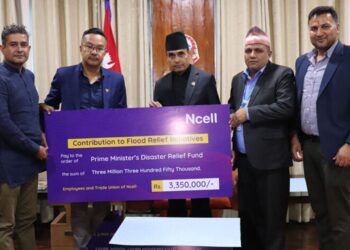
Ncell also says it has invested more than Rs. 2 billion in CSR (Corporate Social Responsibility) and community initiatives since its establishment. Recently, the company made significant contributions to the government with satellite communications and funds in the aftermath of the deadly Rasuwa floods, to ensure connectivity and assistance in rescue and rehabilitation efforts.
Such initiatives have extended beyond the company’s core telecommunications business and included support for communities and social causes.
This is another important part of the company’s footprint in Nepal. Since its advent, the company has consistently made efforts to uplift the government and the people, particularly at times when communities have faced disasters and other challenges.
✔️ How to Transfer Balance in Ncell SIM?
Ncell timeline: A journey that mirrors Nepal’s digital evolution
Ncell’s history can be viewed as a timeline of Nepal’s own telecommunications transformation.
- 2004: Spice Nepal Pvt. Ltd. established
- 2005: Mero Mobile service launched
- 2008: Acquired by TeliaSonera
- 2010: Rebranded as Ncell; 3G network launched
- 2016: Joined Axiata Group
- 2017: 4G services launched
- 2020: Converted into a public limited company
- 2023: Acquired by Spectrlite UK Limited
- 2026: More than 14 million subscribers and 4G coverage reaching around 95% of Nepal’s population
What began as a mobile service brand more than two decades ago has become a major part of Nepal’s connectivity infrastructure.
Ncell maintains its legacy with its 21st anniversary
As Ncell marks its 21st anniversary, its story is also a reminder of how dramatically Nepal’s telecommunications landscape has changed—from limited mobile access and basic voice services to a country increasingly dependent on mobile broadband and digital platforms.
The business environment has been more challenging than it was during the industry’s rapid-growth years. Telecom revenues have declined, while the cost and importance of maintaining modern networks continue to grow.
Yet the demand for connectivity has never been greater.
For Ncell, the next chapter will therefore not simply be about connecting more people. It will be about how telecommunications infrastructure can continue to support Nepal’s digital transformation, businesses, communities, and the country’s emerging digital economy.
After 21 years, Ncell’s journey remains closely intertwined with Nepal’s journey toward becoming a more connected and increasingly digital society.