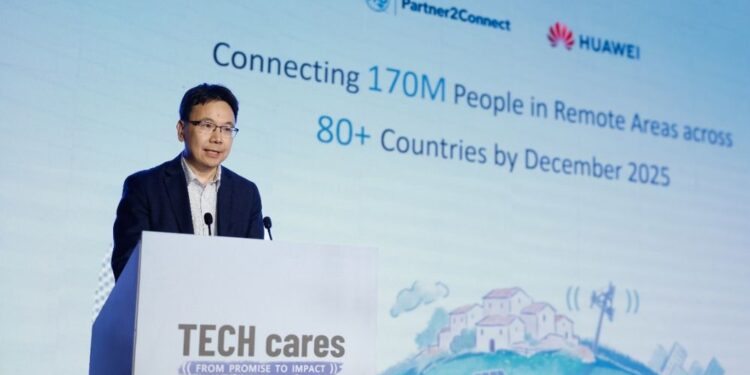
Chinese tech giant Huawei has successfully provided digital connectivity to 170 million people in remote areas across 80+ countries, as part of its pledge to the International Telecommunication Union (ITU) Partner2Connect (P2C) Digital Coalition.
The announcement was made by Yang Chaobin, CEO of Huawei ICT BG, at the company’s TECH Cares Forum in Barcelona during a Mobile World Congress (MWC) 2026 event. He stressed that the feat exceeds Huawei’s commitment it made while joining the ITU P2C Digital coalition 2020. The initial target was to connect 120 million people in remote areas by 2025. Yang expressed his gratitude to Huawei’s telecom customers and partners for their collective efforts to reach the goal distinctly.
The forum was graced by 80 guests representing governments, industries, partner organizations, and international bodies. The participants engaged in discussions on the need to advance digital inclusion in the AI era, finding practical solutions and building consensus for multi-stakeholder collaboration.
Partner2Connect Digital Coalition reflects Huawei commitment to serve communities
In his speech, Yang pointed out that the digital divide persists despite growing connectivity. “High-speed digital networks and robust computing capabilities are essential foundations for an inclusive and sustainable Artificial Intelligence era,” he said. The fulfillment of the ITU P2C pledge, he added, reflects Huawei’s ongoing commitment to innovation — launching high-quality connectivity to underserved communities and ensuring access to healthcare, education, and financial services.
Cosmas Zavazava, Director of the ITU Telecommunication Development Bureau, appreciated Huawei’s efforts to bridge the digital divide. “Connecting the rural and underserved communities requires innovative business models, inclusivity, and the effective use of communication resources, as well as community engagement, and sustained investment in local capacity. I applaud Huawei’s commitment to universal and meaningful connectivity, and I am proud of our strong and successful partnership.”
Similarly, Jeff Wang, President of Huawei Public Affairs and Communications, stressed that digital inclusion rests on two pillars: inclusive connectivity and digital skills empowerment. He said that to address the digital skills gap, Huawei partners with governments and organizations to support students, youth, the elderly, and women through three initiatives: expanding digital access, offering digital skills training, and developing STEM curricula.
Huawei is consistently working in underserved communities to bring connectivity
Since 2019, Huawei’s Skills on Wheels program has brought mobile digital training to over 130,000 people across 21 countries, unlocking for them new opportunities and uplifting communities.
Marina Madale, Executive of Sustainability and Shared Value at MTN Group, states that connectivity is not a privilege; it is foundational infrastructure for Africa’s growth. In alignment with Jeff Wang, she noted that MTN aims at expanding rural connectivity, driving device affordability, and building digital and AI-ready skills.
In remote network works, the company has been continuously upgrading Rural Series solutions since 2017 to improve affordability and deployment efficiency. The Huawei RuralCow initiative extends coverage to villages with around 1500 residents with support from MTN Nigeria. These have helped connect 170 million people, bridging the digital gap and promoting communications in the underserved areas.
During the forum, Huawei expressed willingness to deepen cooperation with governments and other international bodies. All the participants were on the same page that the AI era requires joint efforts from the stakeholders, including the government, enterprises, and international bodies.
Huawei has reiterated its commitment to work on rural network technologies, deepen open collaboration, and speed up digital skills empowerment.