Last Updated on September 3, 2026
Summary✨
- The last connected cell tower data helps search and rescue teams locate missing individuals after disasters like floods.
- While it provides valuable clues, it cannot pinpoint exact locations due to the vast coverage area of cell towers.
- Losing connectivity doesn’t confirm someone is a flood victim; various factors such as battery failure or network damage can cause it.
- Emergency ‘War Room’ was established to support rescue efforts by optimizing network parameters and delivering equipment.
- Telecom companies cannot share location data with the public, but authorized agencies can access this information in emergencies.
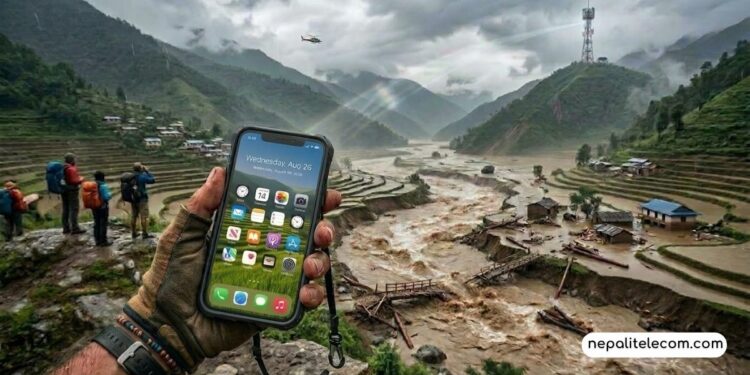
When a flood cuts off communication, the last known mobile tower location data of affected people can provide an important clue for search and rescue teams. Following the Bhotekoshi flood in Rasuwa and Nuwakot, mobile network data became helpful for authorities to understand where a missing person may have been before their phone lost connectivity.
How does the last connected tower location help identify the flood victim location?
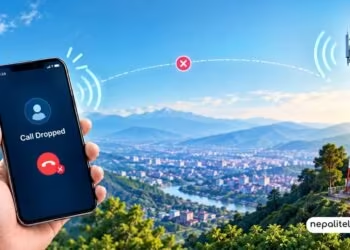
A cell phone connects to a nearby cell tower to enable voice and data services. Each tower only covers a specific area divided into multiple cell sectors. When a phone loses network connectivity due to any reasons during the disaster, the network can still retain information about the last tower or cell sector to which the phone was connected.
This is incredibly useful when searching for people who have become unreachable during and after floods, earthquakes, or any man-made or natural disasters.
👉 Namaste WiFi Wireless Broadband Price and Packages
Last location can narrow down the search area
A missing person’s last connected cell sector becomes useful in tracking his location. Suppose a person’s phone was last connected to a cell sector covering the Bhotekoshi river in Nepal China border shortly before the flood disruption. Rescue authorities could use that information as a clue to determine whether the person was likely in the affected area.
Similarly, if the phone’s last connection was through a sector covering a settlement or higher ground, it may indicate that the person was in or had moved toward that area.
The information becomes more useful when combined with other details, such as the person’s home location/traveling info, reports from family members (last communication), eyewitness accounts, and the known movement of the flood.
But it does not show the exact location
However, it must be kept in mind that the last mobile location data can’t pinpoint the exact location of a missing person. So, it should not be confused with GPS tracking. Because the mobile operator doesn’t know the location of the person, without location-based services enabled in the network.
The network generally shows the tower or cell sector with which the phone was connected, not the person’s precise position. A single cell can cover a relatively large area, especially in rural and mountainous parts of Nepal.
As a result, the last connected tower can only provide a general indication of where the phone was, rather than showing exactly where the person was standing. However further drill down of the user data could provide an important information regarding the distance of the mobile from a particular base station, which we call Timing Advance, but it needs more analysis rather than upfront cell tower.
It can also help track foreigners’ mobile number if they are on roaming with the Nepali mobile operator (Ntc or Ncell).
This means rescuers cannot simply enter a mobile number into a system and see the victim’s exact location (latitude, longitude) on a map. Instead, the information can help narrow down the area that needs to be searched to find the missing people or bodies, sadly.
A phone going offline does not mean the person was lost
Another important fact we should keep in mind is that losing network connectivity does not necessarily mean the person has become a flood victim.
There are numerous reasons behind the phone going offline. The phone may have run out of battery, been switched off, suffered water damage, or been left behind. In the Bhotekoshi flood, the network outages took place because the towers themselves were also affected, with damage to the network sites, meaning a person’s phone could lose connectivity simply because the serving tower or supporting infrastructure was damaged.
Therefore, a last network connection should be treated as a clue rather than proof of a person’s location or condition.
However, if a mobile number gets disconnected to an operational tower at the time of the disaster, then it could lead to reasons like phone damaged due to the disaster or moved out of the coverage zone.
➤➤ Ncell restoration works for Rasuwa flood affected areas
‘War Room’ during the Bhotekoshi flood
After the Rasuwa floods, telcos set up an emergency war room with their own technical experts and support from equipment providers like Huawei. The team also had support from Huawei experts in Thailand, Malaysia, and its international headquarters.
The team has also coordinated helicopter delivery of portable generators, battery banks, fuel and other equipment to remote sites such as Ramche and Nyupanechaur, while optimizing network parameters to expand coverage/capacity in areas where towers were washed away. More interestingly, during the outage of most sites, a single tower was made to handle huge number of subscribers and calls with innovative technologies.
✔️ Nepal Telecom restoration works for Rasuwa Flood affected area Sites
Telecom operators cannot give the location directly to everyone
It’s also true that telecom companies don’t provide location details of missing people to just everyone. They have to comply with the rules and regulations of the country. Telecom operators generally cannot provide an individual’s location data directly to family members simply on request.
During an emergency, however, authorized government agencies, rescuers, and security enforcement agencies can seek relevant network information through official channels. Such data can become vital parts of search, rescue, and disaster-response operations. Likewise, the cellular operator did send an early warning alert (Bulk SMS) to the people lying in the lower belt of the Bhotekoshi river to make them aware of the flood and move to higher grounds. This traditional approach of informing people for disaster alert can be replaced with cell broadcast system, which is not in proper place for Nepali telcos.
The Bhotekoshi flood has highlighted how existing telecom infrastructure can provide useful information during the disaster. While a mobile network’s last location cannot pinpoint a flood victim’s exact whereabouts, it can give authorities a valuable starting point and help them focus search and rescue efforts on the most likely areas.
🚀 Ncell VoWiFi Service: Activation and Tariff