Last Updated on September 15, 2026
Summary✨
- Call drops occur when a phone call disconnects unexpectedly, often due to weak network coverage or congestion.
- Common reasons for call drops include poor indoor signal, mobility between towers, and high user traffic.
- Other factors can also cause call drops, such as switching between different networks or issues with your phone.
- If you experience frequent call drops, try moving to a better signal area or restarting your phone.
- The Nepal Telecommunications Authority used to have a provision for compensation due to call drops caused by network issues.
Have you ever noticed that the call has abruptly disconnected without you or the receiver hanging up? Surely, it’s annoying and frustrating. And for a while, you may blame the other user for ending the call, but what if that’s not the case? In telecom terms, it’s a call drop. And you may blame the network for it, but again, there are several reasons why a call suddenly disconnects. This post guides you through why call drops happen.
In simple words, why do call drops happen?
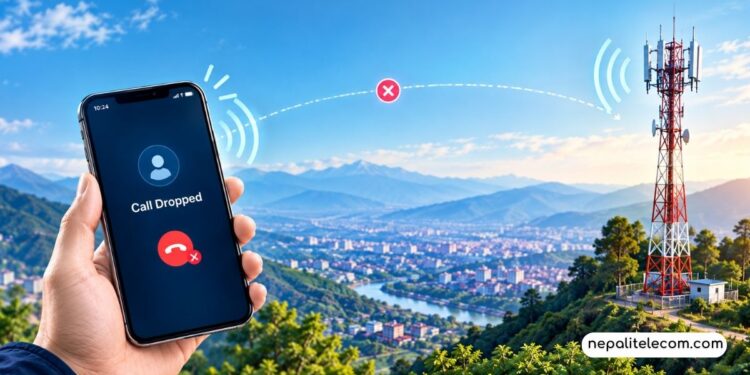
A call drop happens when an ongoing phone call gets disconnected suddenly before either caller ends it. Usually, it is caused by weak network coverage, while in other cases, congestion, mobility between cell towers, or even your phone can be responsible.

Here are some common reasons why your calls may drop.
Reasons behind call drops
1. Weak mobile network coverage
One of the most common reasons for call drops is weak network coverage.
Mobile phones need a consistently stable connection with a nearby cell tower to maintain a call. But when you are inside a building with thick concrete walls, underground, in a remote area, or somewhere surrounded by hills, the phone may struggle to maintain a strong signal. Being too far away from the cell tower also affects the call, due to the poor signal coverage.
When the signal indicator on your phone shows only one or two bars, it’s telling you that the tower nearby is not able to serve you due to your location. But it’s also true that having fewer signal bars doesn’t necessarily mean poor network strength. But it’s one factor to keep in mind.
If you find yourself in such a place, chances are that your cellular call will result in distorted voice or disruption.
👉 How does Mobile network work? Complete Guide to Signal, Towers
2. Moving from one tower to another
Your phone call connects because your phone is latched to one particular tower (BTS) at a time. But when you are travelling during a call, your phone may need to switch its connection from one mobile tower to another.
This process is called handover. The process is automatic and happens without you noticing. For example, you may be talking on the phone while inside a bus or any vehicle. When your phone connects to the other nearby tower, the transition is usually smooth. However, if the next tower doesn’t have good coverage, your call drops.
3. Too many people using the network
Mobile networks become busy when many people use them at the same time. This happens especially in crowded areas like cities, concerts, festivals, fairs, protests (sic), marketplaces, etc. Let’s add emergency situations when a large number of people have to use telecom services at the same time.
So, when the network is occupied, it can’t serve everyone. Calls become difficult to process and complete, resulting in call drops.
4. Indoor coverage can be weaker
Mobile coverage is likely to be worse in indoor conditions. Radio waves don’t travel properly through concrete walls, aquariums, glass, metal, etc. In basements too, mobile signals don’t work as strongly. So, if you place a call from such areas, always expect that the call may suffer in quality or even drop abruptly.
5. Switching between 4G, 3G and other networks
When your phone switches between different networks, call drops may happen too. Depending on the location and availability, your phone’s system looks for the best possible network available. In places where networks are inconsistent, you will face this issue. If the network transition is not smooth, calls drop.
🚀 Mobile Number Portability In Nepal
6. Your phone can also be the problem
It may not always be a network-related factor either. Sometimes, it can be an old phone, SIM, software issue, etc., behind call drops. Therefore, if others are able to place calls without an issue in the exact same location but you are having problems, it’s worth taking your phone for a checkup.
7. Network maintenance or technical problems
Operators carry out maintenance and upgrade equipment from time to time. During such hours, calls become difficult. Telcos do notify users of the timing of maintenance work. And during these times, calls, data, and SMS services may not be smooth.
What can you do if your calls keep dropping?
If you frequently experience dropped calls, you can try a few simple things:
- >Move to a location with better signal, such as near a window or outdoors.
- >Check whether other people are experiencing the same problem.
- >Toggle flight/airplane mode and switch back to normal mode to see if calls work.
- >Restart your phone as it might solve the case too.
- >Update your phone’s software if available.
- >If calls frequently drop in different locations, contact your mobile operator and report the problem.
✅ How to reset phone network settings on Android and iOS?
Provision against call drops
To save customer from irritating call drops, there was a provision of compensation for call drops in Nepal. The regulator, Nepal Telecommunications Authority (NTA)’s Telecom Service Quality Bylaw used to have a provision such that operators need to provide the cost of the total pulse of a call made to users in case a call drops due to a network issue. The fund is to be deposited into the user’s mobile balance. However, the provision could not come into effect.
But as mentioned above, a dropped call is not attributable to network issues. An old phone, the state of the antenna inside the phone, SIM issues, the phone’s software, etc., could be the reasons behind call disruption too.
FAQs on Call Drops in Nepal
A call can disconnect because of weak network coverage, network congestion, movement between mobile towers, indoor coverage problems, or issues with your phone or SIM card.
No. A call drop does not always mean there is a problem with the mobile network. Your phone, SIM card, software, or poor indoor signal can also cause a call to disconnect.
Yes. Your phone may need to switch from one mobile tower to another while you are moving. If the handover between the towers is not successful, the ongoing call can drop.
Nepal has a regulatory provision related to compensation for certain network-related call drops. However, as stated in the article, the provision has not been brought into effect, so users do not currently receive compensation under that provision.