Last Updated on February 12, 2026
Nepal’s 82% households have internet access, and 85.1% of them have at least one smartphone. However, despite the growing connectedness, when it comes to digital skills, the stats sharply fall behind. These figures come from the recently released data in the Nepal Multiple Indicator Cluster Survey (NMICS) 2024/25.
Internet and smartphone access status
The survey was conducted on a total of 12,802 households. Out of which, 82% of them showed to have internet access, and 85.1% a smartphone. Likewise, it was found that 42.8% had a television, while over 95% had at least a mobile phone (not to be confused with a smartphone). It also showed that desktops, laptops, and tablets were at 16.8%.

However, legacy means of communication,s such as radio access, fell flat at 14.7%.
The figure shows a discrepancy among regions. In Urban areas, 86.5% of the total have access to the internet, while in rural areas, it stood at 73%, but it is not discouraging at all. Instead, the figure highlights the growing pace of digital inclusion in Nepal. 4G has reached 98% if local levels, while FTTH is in 77 districts. These also prove that connectivity is reaching more households than ever.
Similarly, 88.9% households in urban aareas nd 77.5% of them in rural areas own a smartphone.
In terms of provinces, Gandaki has 87.5% of households with internet at home, while Bagmati trails with 85%. Karnali stands at the bottom with 68.5% of households having internet facilities at home.
The survey reports that 90.4% of men between the age 15 and 49 own a mobile phone, while 81.6% of women in the same age group own their own mobile phone. If we break it down in terms of people with different economies, it shows that 52.9% of households in the economically disadvantaged group have access to the internet, but among the rich, it stands at 99.2%. This indicates that economic conditions clearly affect internet access.
But lacks digital skills
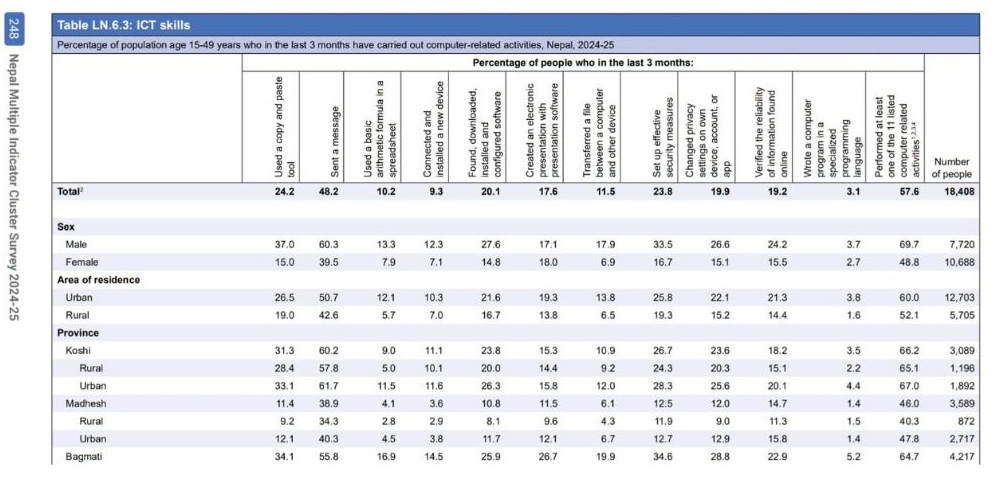
Despite growing internet and smartphone penetration, the survey shows that people lack digital skills for productivity and other tasks. It showed that only 3.1% could write a program in a specialized programming language, and 10.2% used a basic arithmetic formula in a spreadsheet.
The survey also showed that only 19.2% of those in the survey verified the information they found online. Check out: How to Change the WiFi Internet Password of Your Router? [2026]
It is also noteworthy that only 24.2% could copy and paste files on electronic devices. Going further, it shows that only 9.3% could install flash drives, printer and other devices.
The report highlights the disparate internet access status in the country. But there are some positives. Connectivity is penetrating further and reaching more households, while the distribution is in need of attention in western Nepal. It also shows that economic disparity is playing a role in influencing access to the internet.
But a concern should also be about the digital skills. Though many people now have communications and smartphone access, their digital skills are lacking. From verifying internet information online to other skills such as installing programs, transferring files, etc., users are lagging far behind. The government needs to focus on enhancing digital literacy, digital literacy, while also bringing the latest connectivity service across the country.