Last Updated on June 19, 2026
Summary✨
- Nepal Telecom aims to improve 4G services by adding cell towers or increasing 4G bandwidth, amidst congestion issues in urban areas.
- The company has introduced an additional 5 MHz bandwidth in the 800 MHz band, bringing total resources to 35 MHz for 4G services.
- High utilization rates of 60% nationwide and nearly 100% in urban areas cause slow data for users, prompting calls for bandwidth increases.
- Challenges exist in adding cell towers due to homeowner restrictions, especially in Kathmandu, impacting service quality.
- 5G rollout faces delays due to low phone penetration, high infrastructure costs, and skepticism about immediate market needs.
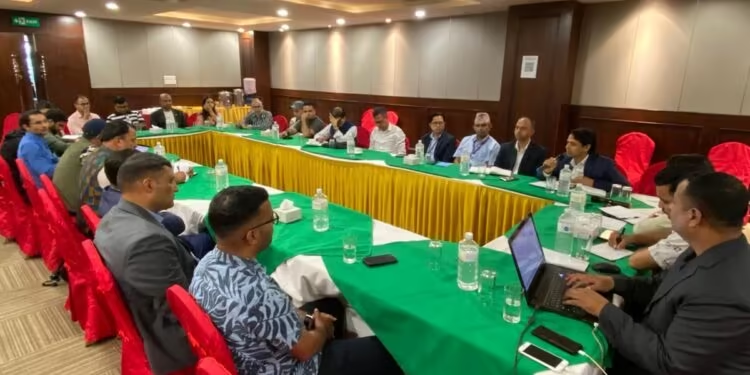
Telecom operators need to add frequency bandwidth, or cell towers to improve the 4G network. Nepal Telecom (NT) is working to improve 4G services, including voice and data, for users across the country with more resources in its base stations. Adding more towers or bandwidth to improve the service quality has remained a debate. The development was shared during a recent program organized by Tech Journos Forum (TJF) in Kathmandu.
The company recently brought in additional 5 MHz bandwidth in the 800 MHz band. It means the state-backed telco now has 15 MHz of bandwidth in the 800 MHz band, up from 10 MHz.

Likewise, the company boasts 20 MHz frequency in the 1800 MHz band. The company was using 5 MHz of the 1800 MHz for 2G before, which is now known to be shut down completely. So, all of the bandwidth in 1800 MHz is being used for 4G. In total, the company now has a total of 35 MHz of frequency resources in the 800 MHz and 1800 MHz bands; the two 4G band of NT.
According to the company, it’s an average utilization of over 60 percent if we look at the entire country. We can also see 40% of the resource just goes to waste, without adding any penny to the operator. However, if we look at only the densely populated urban areas, it crosses the 99% mark, and making the 4G data very slow, due to resource congestion.
| NT 4G Spectrum bandwidth and utilization | Details |
| Existing spectrum in 800 MHz band | 15 MHz |
| Existing Spectrum in 1800 MHz band | 20 MHz |
| Total 4G spectrum resources (800 MHz + 1800 MHz) | 35 MHz |
| Average spectrum utilization nationwide | ~60% |
| Spectrum utilization in dense urban areas | Nearly 100% |
Cell Tower addition, Bandwidth increment for 4G service improvement
As there is a huge congestion in the 4G network in city areas, the telco wants to improve the user experience by adding cell towers or more frequency bandwidth. In the program, NT shared that they might need more bandwidth in 800 MHz in the future for increasing the network quality. Adding 5 MHz to the 800 MHz band to bring it to 20 MHz is an option to increase the bandwidth capacity. “We have already sent a proposal to the Nepal Telecommunications Authority (NTA) and the Communications Ministry for this. If this proposal is approved, we can increase the frequency to 20 MHz using the existing hardware of the company, Rajendra Dulal, Deputy Manager at Nepal Telecom, said. He said that increased bandwidth will improve the 4G service experience, using the same hardware.
According to the telecom, the utilization of the frequency bandwidth in urban areas is very high. Dulal shared that the utilization has reached almost 100 percent, and some customers are even experiencing slow data due to it.
✅Factors affecting 4G speed in Nepal
“The solution for this is to increase the bandwidth or increase the site (cell tower). There are many problems in increasing the site in big cities, including Kathmandu. The problem has increased since the earthquake. Telecom is running out of around 200 sites in the capital alone. Houseowners are not allowing them to install towers and equipment. In some places, even after going to the site and installing the equipment, they have to remove it. This is also affecting the quality of Telecom’s service,” said Dulal.
Besides adding bandwidth, the company is also refarming frequency resources to improve its 4G services. Telecom officials also said that the inability to add more base stations in the cities has been affecting service quality in urban areas.
Road to 5G launch maybe in haste or not!
On the launch of 5G, Dulal said that the lack of 5G phones derailed the rollout of 5G for public, when it was trialed 3, 4 years back. The 5G penetration was around 5% at that moment. He said that currently, 20% of smartphone users have 5G phones. But the practice of locking 5G in supportive handsets hinder the required tests for 5G trials. There are reasons why phone manufacturers lock 5G network before the launch?
He further added that 5G infrastructure costs 3 to 5 times more than 4G, and since 5G requires many towers to operate, the investment will be huge.
Therefore, 5G service is being focused on a limited number of metro cities (that too in limited scope), keeping in mind the market conditions and return on investment. For now, the use cases for 5G will be limited just to MBB, as low latency applications and Massive IoT or Industrial IoT has not yet taken a big shape. So, the question also remains high on the probable use cases if they have to invest so huge on 5G.
On the contrary, telecom expert Ananda Raj Khanal warned that the eagerness to launch 5G may turn counterproductive. He pointed to complaints about the quality of 4G services and suggested that haste in rolling out 5G could further increase dissatisfaction.
He said that ensuring high quality is a challenge as the telecommunications sector is constantly changing and complex. He also questioned the autonomy of the regulatory body and commented that the expected improvements in the telecommunications sector have not been achieved. He said that an environment is necessary where the regulatory body can formulate policies and make decisions independently.
At the moment, NTA is proceeding towards a 5G spectrum auction in Nepal. However, experts have remained skeptical about its success as operators have remained less interested in paying huge on 5G airwaves owing to the limited market in the current telecom landscape in the country and sustainability issue.