Last Updated on January 28, 2026
The broadband penetration in Nepal continues to reach new milestones. According to the latest Nepal Telecommunications Authority (NTA), the total data coverage has reached 143.01% in terms of population penetration. In this post, we provide details of connectivity status across Nepal from mobile to fixed line, and other broadband services.
A few years ago, the country’s telecommunication penetration was measured by its teledensity. But now broadband connectivity has entered the equation. If you were not aware, teledensity is the percentage of telephone access to people. But now mobile and broadband internet penetration have become key indicators for the state of communication access to people. Below in this post, we update broadband penetration among major telecom services (fixed and wireless) in Nepal as per the latest MIS report by NTA for Mangsir 2082.

But first, let’s understand by understanding the meaning of broadband internet:
Recommended: 5G vs Fiber: The battle between the wireless and the fixed broadband
Table of contents
What is broadband internet?
The common understanding is that broadband means high-speed internet. It sounds the same, too, but it requires a careful definition. What is broadband internet? It means a type of connection that transcends regular or old-generation internet speeds. This varies from country to country. Because depending on a country’s needs, and capacity, broadband internet harbors different means. So, that leads us to the inevitable – What is considered a broadband connection in Nepal?
Earlier, an internet connection with a speed greater than 512 Kbps was considered broadband internet in Nepal, as per the NTA broadband policy. Previously, every home with internet access other than dial-up connections was considered to have broadband internet. But nowadays, broadband internet does not include GPRS, EDGE, or any other lower-speed internet connection from older generations. Fortunately, most of the areas in Nepal today have a high-speed mobile broadband connection as telcos have accelerated their network expansion in rural areas too. So, broadband internet shall have to be in Mbps or probably at least in ten.
But if we calculate the total internet penetration, including all of the slow-speed services, then the total population connected by the internet would soar very high. We hope we have cleared you enough on the perceived meaning of broadband internet in Nepal. Now, let’s head to the factual data.
Find out: Meaning of Mobile Network Signs | G, E, 3G, H/H+, 4G, 5G, VoLTE
Mobile broadband in Nepal
Mobile penetration has reached 88.86%. The figure does look encouraging; however, the real-time data escapes areas where connectivity still remains absent. The real data is lower than that, as that would actually count the unique mobile service subscribers. If we take into account dual SIM customers, SIM owners who moved abroad, old age/infant people, discarded SIM cards, etc., the unique mobile penetration would come down for sure.
Broadband service includes cellular connection in mobile technologies such as WCDMA/EVDO (3G), and LTE (4G). As of now, we only know that Nepal Telecom plans to launch 5G in Kathmandu and Pokhara in FY 2082/83.
Total broadband Stats in Nepal
Total broadband coverage has certainly improved now as it surpasses well beyond one hundred percent, leaving behind the forgettable suffrage of dial-up internet. With the advent of 4G and FTTH fiber systems whose speeds range from at least 1 Mbps to well above 150 Mbps on average, Nepal’s broadband quality and penetration have seen a remarkable improvement. The fourth-generation mobile network 4G came in 2017 and has gradually led Nepal’s wireless mobile broadband transformation. At the same time, fiber internet service saw a revolutionary transformation in 2021, and to date, there are 33.41 lakh fiber internet users in Nepal.
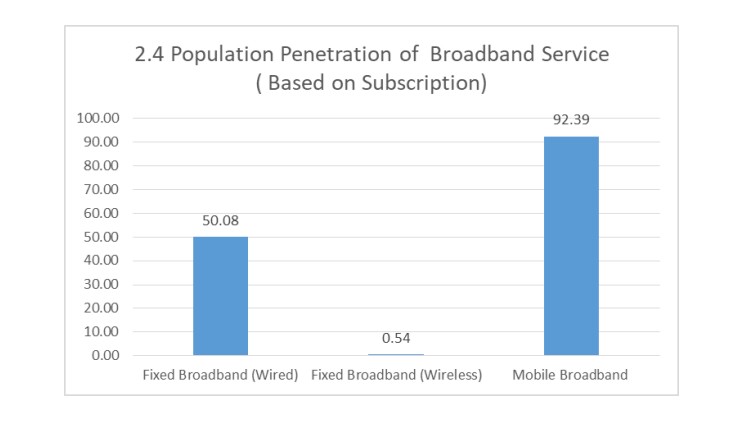
After CG Net bludgeoned the market with a hyper-aggressive 120 Mbps deal, ISPs raged into an internet speed war. Now, a 100 Mbps internet speed has become common among ISPs. As per the latest stats, fixed-line broadband (wired) reach has reached 50.08% by 2082 Mangsir.
Meanwhile, the ADSL has been pushed to the margin with just 588 users. The total has been on a declining trajectory as Nepal Telecom (NTC or NT) has shunned the dated copper-based service and made fiber internet FTTH its default subscription. It is also noteworthy that Ntc is the only ADSL internet service provider in Nepal. The telco now provides a far better and refined FTTH Triple Play service, which has not just thrived in growth and popularity but also helped the company contest private ISPs.
While NT relied on ADSL for its fixed-line internet reach, the company has completely shifted attention to the fiber network and has also introduced Triple Play service that provides fiber internet, data, NTTV, and telephone service through a single fiber cable.
4G dominates mobile broadband service in Nepal
4G is now the most dominant and pervasive cellular technology in Nepal, with 3G and 2G also used across the country. NT has discontinued WiMax, WCDMA, and EVDO, which leaves LTE (4G) as the most advanced and relevant broadband in Nepal. Ntc has discontinued the legacy service and has completed the migration of its existing customers to the broadband network. Like with ADSL, only NT had been providing WiMax, WCDMA, and EVDO services in Nepal, but as time caught up with these older technologies, the company phased them out.
So, speaking from the latest NTA data for Mangsir 2082, 2 crore, 61 lakh, 42 thousand, 1 hundred and 80 users are connected to 4G internet. NT and Ncell are the two 4G service providers after Smart lost its license in mid-2023 over payment dues. Among the two, NT has over 1.44 crore subscriptions on its network, while private telco Ncell also boasts a strong nearly 1.18 lakh 4G users.
Both NT and Ncell provide Carrier Aggregation to deliver higher 4G speeds. At the time of writing this post, both Ntc and Ncell provide 4G-based VoLTE service too which brings the benefits of HD voice calls for subscribers.

The rise of 4G connectivity is attributable to the increase in smartphone reach and vice versa. Smartphone penetration has actively helped grow mobile network expansion and data consumption, especially among the youth.
With 4G expansion growing steadily, the shift to the network has resulted in a gradual decline in the number of 3G users in Nepal. As of now, there are 8 lakh, 1 thousand, 6 hundred, and 85 3G subscribers. It’s obvious that newer 4G technology is becoming more popular thanks to its high-speed data capacity and lower latency.
Don’t miss: 2G or 3G? Which Mobile Network Will Shut Down in Nepal?
The major broadband stats
Here is a table for the calculation of the broadband internet penetration in Nepal, which we think NTA should publish in their MIS regularly.
| S.N | Technology/services for broadband in Nepal | Number of subscribers |
| 1 | 4G (LTE) | 26,142,180 |
| 2 | WCDMA, HSPA (3G) | 801,685 |
| 4 | ADSL/cable | 593 |
| 6 | Fixed Internet via Fiber/Coaxial (ISPs Fiber, Ntc Fiber Net, Coaxial cable) | 3,341,809 |
| 7 | Radio (WiFi) | 36,323 |
| Total broadband users (fixed, wireless, mobile) | 30,322,590 | |
| Total Broadband penetration against the population | 143.01% |
Still room for expansion
That means Nepal still has an immense task to do for the expansion of broadband internet in Nepal, especially in fixed-line services. For this, the regulator has to introduce broadband-friendly policies and encourage service providers to expand to rural areas. This also includes freeing up sub 1 GHz frequencies for broadband networks (4G). In addition, the NTA should also amplify subsidies to the operators for the 4G rollout using the Rural Telecommunications Development Fund. As of now, NTC 4G coverage has reached 749 local levels out of 753. Ncell’s 4G also covers well over 95% of the country.
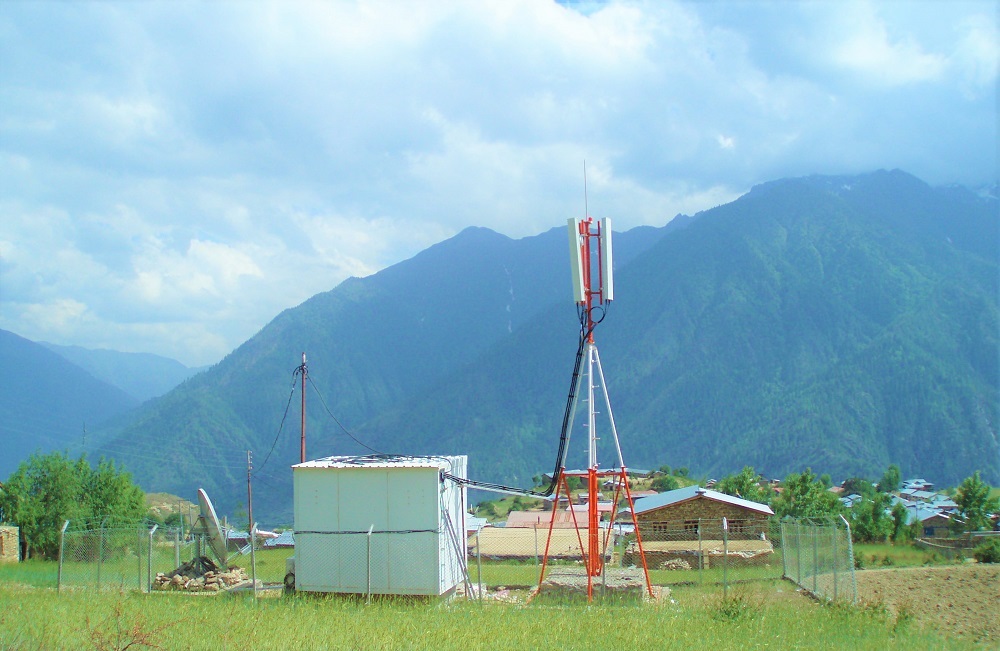
NT has trialed 5G, and another telco, Ncell, is also ready for it. So, in the coming days, the government, telcos, and stakeholders should hold talks to expedite the advent of 5G in Nepal.
Ncell has also introduced Sadhain ON data packs as a preparation for 5G services in the near future. And we must emphasize that we need 5G now, even to stay up to date with technological innovations that’s happening around the world.
Similarly, telecom operators and ISPs both need to jointly invest more resources to provide broadband service and help reduce the digital gap. Wireless broadband is one of the most feasible internet solutions for a country like Nepal with its complex geography, and that is where telcos and ISPs need to focus more on rural expansion.
With Ntc phasing out 2G in the 1800 MHz band and Ncell discontinuing 3G, 4G is now a de facto major cellular technology as the country waits for 5G birth.
Tell us what you think of the Broadband situation in the country in the comments below.