Last Updated on June 9, 2026
Summary✨
- Nepal’s government announces its programs and policies for FY 2083/84. We have IT sector major points here.
- Government aims for a digital economy in FY 2083/84 by promoting AI, digital tools in schools, and IT as a national strategic industry.
- They will introduce high-speed internet at 10,000 community schools and develop digital parks and data centers.
- The government plans to implement a mass transit system and legalize international payment gateways for smoother foreign transactions.
- Furthermore, the e-gate system will allow online tourist visas to improve travel experiences in Nepal.
- Lastly, they will implement a one-ID card policy and offer at least 100 public services on the Nagarik App to streamline access.
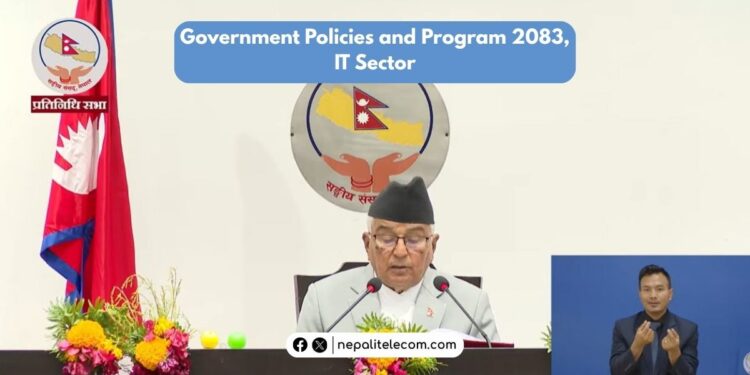
The government of Nepal has announced a sweeping range of policies and programs for FY 2083/84. On May 11, 2026, the honorable President Mr. Ram Chandra Paudel announced the programs of the government at a joint meeting of both houses of the federal parliament. The Balen government has aspired to a transition from a traditional economy to a service-oriented digital economy with digital transformation in its programs. The new sets of aspirations include the mobilization of AI, internet at schools, digital transport system, robust IT entrepreneurship, etc., with the ultimate aim of making Nepal an IT hub in South Asia.
This post guides through all the major policies, plans, and programs of the government (led by Balen Shah) for the upcoming fiscal year 2083/84 and beyond for the IT sector.

Table of contents
- Government policies and programs for FY 2083/84
- New standards for the telecom industry
- High-speed internet at community schools
- IT as a national strategic industry
- Mass transit system for public transport
- Startup Nepal Portal
- Promotion of AI, CyberSecurity, FinTech
- e-KYC and digital Authentication
- AI based traffic control
- Will promote G-Cloud and data policies
- Legal recognition of international payment systems
- Online visa for tourists via the eGate system
- Facial recognition system at the border
- One ID Card policy
- Minimum 100 services on Nagarik App
- Two things we missed
Government policies and programs for FY 2083/84
New standards for the telecom industry
In the programs for FY 2083/84, the president announced that the government will formulate a new set of standards for innovative technology expansion and radio frequency management. The aim is to expand, improve, and promote new innovations and high-quality services for the customers while also helping revive the telco industry that has suffered from declining revenues for the past few years. The government’s policy also includes an improved monitoring system (Spectrum and quality of service) for the telecom industry for its proper operation.
High-speed internet at community schools
The government will establish high-speed internet service at 10,000 community schools in FY 2083/84. At the same time, the government will provide students with AI and digital tools to enhance their learning. In universities, arrangements will be made for e-learning and virtual classes.
IT as a national strategic industry
The government has declared the information technology (IT) sector a national strategic industry and will promote software, digital services, cloud services, cybersecurity, green computing, and AI computation exports.
President Poudel shared that Nepal will be promoted as a tech hub and develop high-quality digital parks, data centers, and public digital infrastructure. Bichuten’s Tier-4 data center project does reflect this goal by making Nepal a growing space for data centers.

“The information technology export industry will be provided with financial incentives, investment facilitation, government co-investment, and tax incentives on innovation expenditure,” he said.
This plan is part of the ruling party, the Rastriya Swatantra Party’s manifesto for technology. Many other political parties also included similar plans for the promotion of the IT sector of the country.
Mass transit system for public transport
The government will develop a mass transit system (MTS) to make public transport more systematic and modern. The president said that the system will be promoted as a long-term solution to public transport in major cities of the country. The decision to develop the MTS is to establish a safe, efficient, and sustainable public transport system, keeping in mind the increasing urbanization and traffic pressure.
Government has also announced to prepare the design and implement Bus Rapid Transit (BRT) in Kathmandu.
Startup Nepal Portal
It has been announced to have a single window platform to provide same day company registration, tax exemptions and seed capital access.
Promotion of AI, CyberSecurity, FinTech
Government has planned to promote using data, AI, fintech and cybersecurity for knowledge based economy.
e-KYC and digital Authentication
e-KYC is said to be implemented for banking, telecom, and public services. Central online vetting system will be implemented to reduce corruption risk and automate services.
AI based traffic control
Government also plan to deploy AI based traffic cameras, GPS tracking, digital fining and speed control for road safety.
Will promote G-Cloud and data policies
The government will proceed towards creating a system for the implementation of G-Cloud and data policies. The system will be part of the broader ‘digital governance blueprint’ of the government.
Speaking at the parliament, the president said that the government prioritizes a national digital strategy, a digital procurement system, data policy, interoperability standards, and government cloud infrastructure.
Legal recognition of international payment systems
The government will give legal recognition to the international payment gateways. By doing this, the president said that foreign exchange earnings and tax management practices will be more straightforward and feasible. The decision helps fast-forward the steps to bring foreign payment systems, such as PayPal in Nepal.
Online visa for tourists via the eGate system
The government will establish an e-gate system at the international airport to provide tourist visas online. It will reduce the waiting time for tourists and improve their experience in Nepal right upon their arrival. The president said that a single-door digital tourism system will come into place to incorporate tourist permits from the immigration point.
Facial recognition system at the border
The government will install a facial recognition system at the border to improve the border security system. Additionally, night vision cameras, drones, etc., will also come into use to tighten security for the border management information system.
One ID Card policy
The government has announced a one ID card policy to streamline public services. In its policies and programs of the government for FY 2083/84, the government will interlink the National ID card with as many public services as possible. These will comprise citizenship, banking, health, education, social security, etc. All these services will be integrated into NID.
Minimum 100 services on Nagarik App
The government will integrate at least 100 public services on the Nagarik App to provide services more easily. A government database will be developed that will use one-time details for all the services. This will eliminate the hassle of submitting details every time a user tries to access a service. Likewise, Government has also planned to provide disaster like flood, landslide Early warning message via Nagarik App.
Two things we missed
In the policies and programs of the government for FY 2083/84, we missed two crucial things for connectivity. The launch of the 5G network in Nepal was missing rather conspicuously. We also didn’t hear much on NTA’s plans to use RTDF funds to expand the mobile network in rural parts of the country.
The digital divide in Nepal is real, and the current efforts need to take effective steps to bear fruit. But it goes without saying that the government has been doing a lot to improve the state of 4G and fiber across the country.
But we did hear the ambitions to make Nepal an IT hub in the coming years and the promotion of IT entrepreneurship.
The government has already started 100 important tasks, and you can see their status on pratipakchya.com. In the meantime, you can submit your suggestions to the government regarding the upcoming budget for FY 2083/84 and development projects.