Last Updated on May 30, 2026
Summary✨
- Mobile networks enable wireless communication for calls, SMS, and data using a system of cell towers, core networks, and transport networks.
- Mobile signals, which are electromagnetic waves, travel from cell towers to phones and can degrade due to distance and obstacles.
- Cell towers consist of antennas and communication equipment to facilitate mobile signal transmission for various technologies like 2G, 3G, 4G, and 5G.
- The connection process involves your phone searching for nearby towers, authenticating with the network, and initiating communication within milliseconds.
- Continuous coverage is maintained through overlapping cell tower coverage, allowing seamless handover as users move.
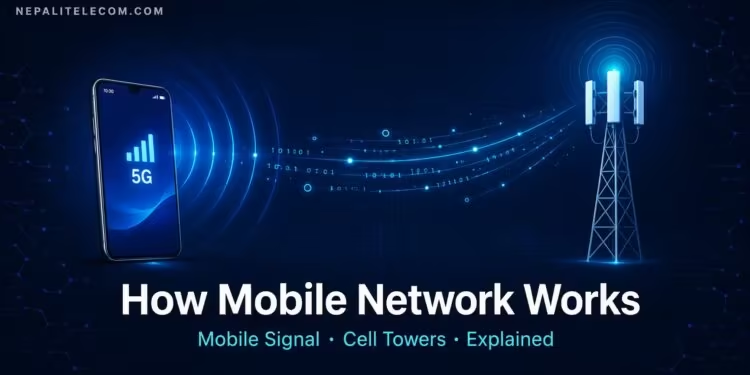
Ever wondered how call connects after you dial, or phone streams video on the street. You need to how mobile signal reaches your mobile and you are able to make calls, SMS or browse data. Well, this comprehensive guide explains simply how the mobile network works, what mobile signals are, how cell towers operate, and how your calls and data travel from your phone to the destination in milliseconds.
Table of contents
What is a Mobile Network?
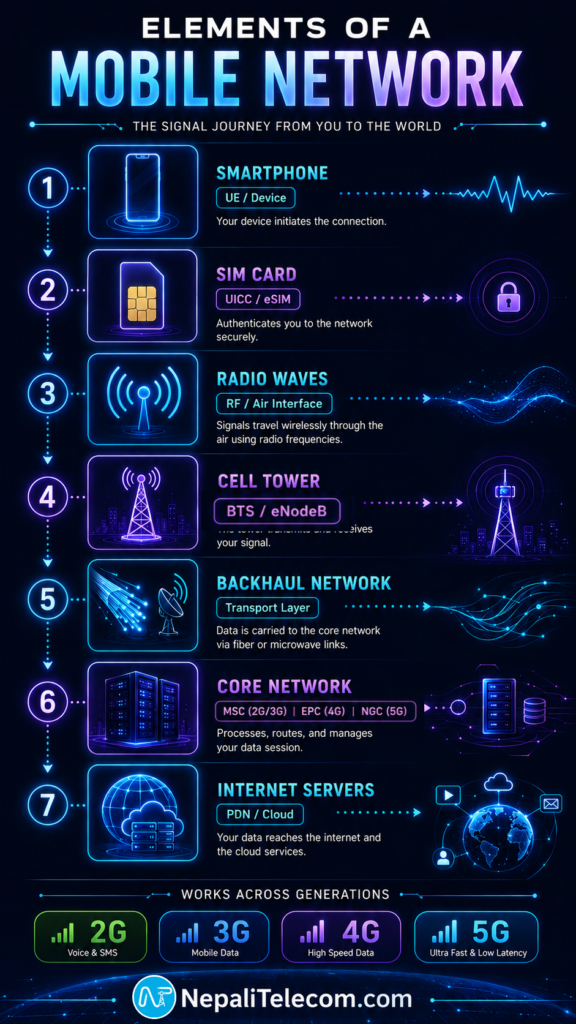
Mobile network is a wireless communication system that enables communication (call, SMS, data) between two nodes wirelessly, while you are on the go, i.e mobile. It is due to this network you are able to call any other person, send SMS or use mobile data while you or the one you are calling or texting are moving. Mobile network is also called Cellular network because the area to be covered by a mobile network consists of several small units called cells. Each cell consists of a radio tower called cell tower or base stations. It is the Cell towers that radiates mobile signal to your phone and also receives the signal from your phone to the mobile network. The elements in a mobile network are:

- Cell Tower or Base stations
- Core Network
- Transport network
- Wireless links and interfaces
- Radio spectrum for wireless access network
- Optical fiber connecting base stations to the core system or other elements
Each Cell tower is capable of handling certain users that is calling rate and maximum data throughout (in Mbps/Gbps). So, the total capacity of the mobile network is sum of the capacity of all the cell towers or base stations for a particular mobile operator. It also depends on the frequency bandwidth and the reuse (as the same frequency is reused at a distance avoiding overlap). Check out: Frequency bands in Nepal for 2G, 3G, 4G and 5G.
What is a mobile signal?
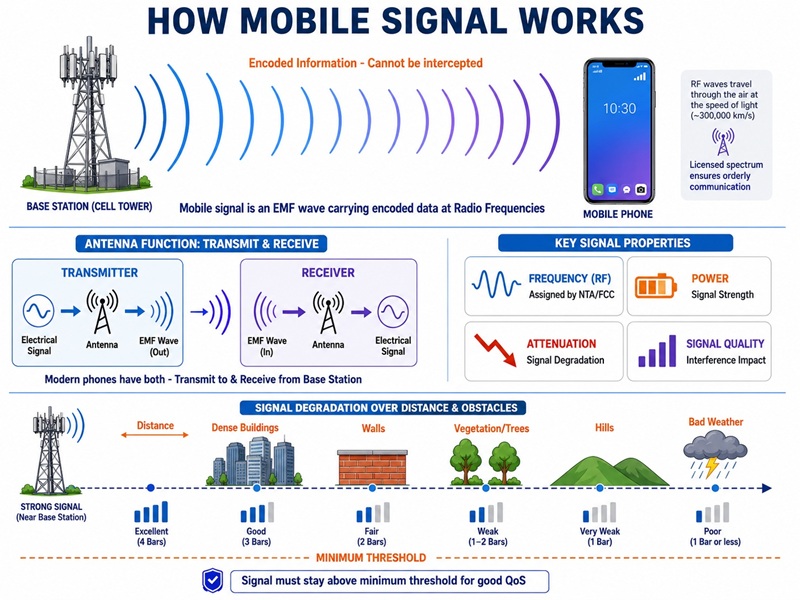
Mobile signal is an EM (Electro-magnetic) wave that the cell tower/base station radiates and reaches your phone wirelessly. It is like a sound wave but works at Radio frequencies (RF) and carry encoded information, which cannot be tapped by other devices. Wireless signals of radio frequencies emanate from a transmitter with an antenna and is received by a receiver also with an antenna. Antenna converts electrical signal to an EMF wave in a transmitter and also converts EMF wave to an electrical signal in a receiver. Modern Antennas are transmitter and receiver in the same physical device. So, your phone has a receiver to receive signal from the base stations and also has a transmitter to send signal to the base stations. The frequency of a mobile signal aka radio spectrum is assigned by a telecom regulator which is FCC in case of USA and NTA in case of Nepal.
Don’t miss: Why do mobile signal fluctuates among 2G, 3G, 4G?
Each mobile signal is associated with:
- Frequency (RF)
- Power (Signal strength)
- Attenuation (signal level degradation)
- Signal quality
Mobile signals level degrades over the distance from the cell towers, dense buildings, walls, vegetation (trees, foliage), hills and bad weather. It is also dependent on the frequency band as higher the frequency band, lower will be the signal coverage due to the higher frequency being attenuated by physical RF environment. So, the mobile signal bar shows one bar or two as the signal strength gets degraded. Similarly, the signal quality also deteriorates if there is interference from another system or within the system due to high frequency reuse.
The mobile signal level shall remain above the minimum threshold to have a good quality of service. Find the thresholds defined by NTA for mobile signal coverage.
What is a Cell tower?
A cell tower is a fixed infrastructure usually located in a higher place and includes communication equipment like base stations, antenna, fiber optics to serve mobile signal in a particular area. Antennas in the cell tower transmits and receives signals from/to mobile phone and routes the communication to the core network. The cell tower is connected to the core network via high-speed fiber network in the city areas and microwave in the rural areas. For areas where optical fiber and microwave is not available, it is also connected via satellite.
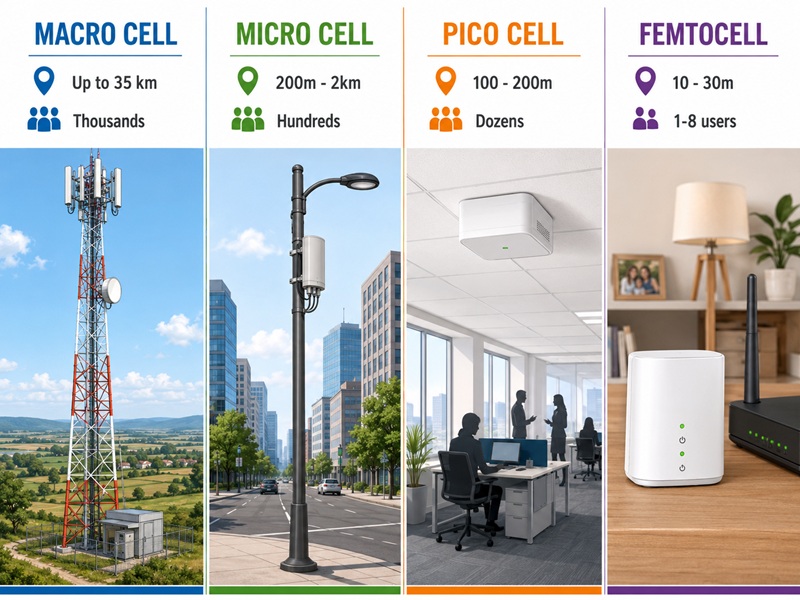
Cell tower can be located on a very large Ground based tower or over the roof of a large building or simply on a street pole/wall. There are several types of cell towers like Macro tower, Micro tower and Pico tower, based on the size of the coverage area (in few kms or less than 1 km in case of high frequency bands) and the capacity of the users to serve simultaneously. That means, there is a capacity of a cell tower that determines how many users can be connected to the tower at a time. If the tower serves a greater number of users, crossing the capacity of the tower, call attempts from new user is rejected.
If a nearby cell tower becomes dead due to an outage, the signal may reach from another tower next to it.
The cell towers are available for different technologies; 2G, 3G, 4G and 5G and are called as:
| Technology | Tower name |
| 2G | BTS |
| 3G | Node B |
| 4G | eNodeB |
| 5G | gNodeB |
How do we get continuous coverage with cell towers?
A cell tower covers specific area; however cellular network is designed in such a way that there will be overlap between the cell towers. So that when a user moves, it will hand over from one tower to another smoothly (possible due to the overlap). This makes continuous coverage for the user and call does not drop.
How your phone connects to a Cell tower?
The process of connecting your phone to a cell tower is as follows:
- You turn on a phone, it searches available towers nearby.
- Detects the strongest signal from the tower which is normally the nearest tower.
- Authenticates your number via SIM parameters.
- Registers your number to the network
- Now you can access the network for calls, text and data.
- When you move, your phone may connect to another cell tower, if the strength of the current tower gets degraded.
What happens when you make a call?
When you make a mobile call, your signal is converted to digital bits and travels to the connected cell tower which routes the signal to the core network. After analyzing the number dialed, it will track the recipient’s phone and connects via a switching center (MSC).
Here is the complete journey of a call from your phone to cell towers to Core to recipient phone, explained simply.
- Your phone is connected to a tower, and you dial a number, then the number is converted to digital bits.
- The digital signal travels through waves to the cell tower and is routed via transmission link to core network.
- The core network finds the recipient’s number and assigns the path to it and connects to your phone via switching center.
- The voice you speak is converted to digital signal via Analog to digital converter (ADC) and flows through the EM wave to the cell tower.
- The cell tower hears your phone signal and sends to the core network.
- Core network processes your phone signal to another core/Switch.
- Similar reverse path to the recipient’s phone via its nearby cell tower.
- The call connection happens within milliseconds, and connection remains until the signal is above the threshold or either one of them disconnects.
Check out: How to improve mobile signal on your phone?
Your mobile number needs to have enough balance or plan and validity date to access the mobile network.
We recommend you go for modern technologies like VoLTE, VoWiFi to get good quality voice over the cellular network.
What Happens When You browse a website/app?
When you browse a website or mobile app, your phone converts the request to digital bits and travels to the connected cell tower which then sends the request to the core network. The network checks your profile for data service, or balance or data plans and then assigns an IP address. After performing DNS resolution (to get IP address of the destination website), the request from the user is sent to the web server. Then the server sends back the response to the request (web page) to your mobile.
Do read: Factors affecting 4G speed
FAQs
Here are some of the frequently asked questions for a mobile network and mobile signal.
Mobile signal travels wirelessly using Electromagnetic waves from the cell tower to your phone. Your phone antenna receives the signal provided it is within the threshold.
Even if you have full bar signal, you cannot make phone call means the connected cell tower is congested, crossing its capacity.
The phone data capacity does not only depend on the signal bars but on the number of users connected in the cell, other user high multimedia usage, signal quality (not just levels).
Yes, thick walls block mobile signals and degrade the signal levels heavily.
The maximum range of a cell tower depends on the type of cell tower, but it normally ranges to few kilometers.
The capacity of a cell tower is determined by the number of users to serve at a time.
When you make a call, it connects and sends the number dialed to the core network, finds the recipient’s location, and establishes a connection between them.
Call drop happens when a signal drops suddenly below threshold while moving.
If you cannot get a mobile signal, it could be due to issue on your SIM or phone, or you are far from the cell tower or the nearby cell tower is dead.
Mobile signal gets weak inside house, as the concrete, windows, doors of a house block or degrades the signal level.